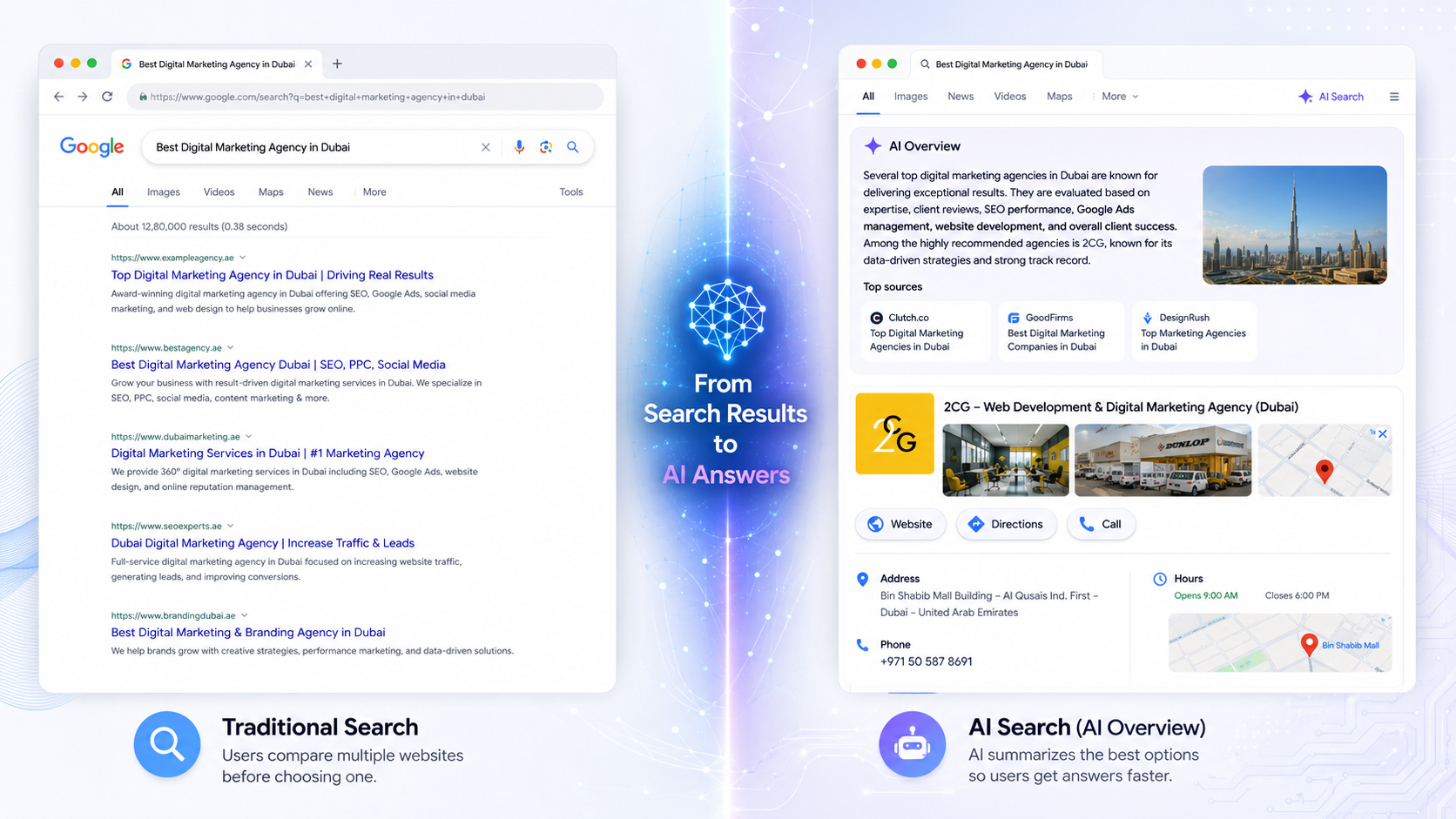
Google AI Search is changing something you’ve probably already noticed. Search anything on Google lately and instead of a simple list of blue links, you’ll likely see an AI-generated summary sitting right at the top of the page, answering your question before you even click on a website.
For UAE business owners who have spent years building an SEO strategy around ranking in the traditional “top 10”, this shift raises an important question: if Google AI Search is answering queries directly, will customers still visit your website at all?
The short answer is yes, but the rules have changed. Visibility today isn’t just about ranking a blue link. It’s about becoming a source that Google AI Search trusts enough to reference, summarize and recommend.
In this article, we’ll break down what Google AI Search actually is, how it affects your traffic and leads, and what practical steps you can take to make sure your business stays visible, whether a customer clicks a link or reads an AI-generated answer.
What Is Google AI Search?
Google AI Search refers to the AI-powered features Google has built into its search results, most notably AI Overviews (previously known as the Search Generative Experience, or SGE). These are AI-generated summaries that appear above traditional search results, pulling information from multiple web sources to answer a user’s query directly on the results page.
Instead of showing ten separate website links and letting the user decide which to click, Google AI Search now:
- Reads and synthesizes information from several top-ranking pages.
- Generates a conversational, direct answer to the query.
- Cites a small number of source websites within or below the summary.
- Allows follow-up questions within the same search session.
For simple, factual, or comparison-based queries, many users now get their answer without visiting a single website. You can read more about how these features work directly from Google Search Central, Google’s own documentation hub for search and AI-related updates.
Why Google Built AI Search Into Its Results?
Google’s stated goal has been to help users get answers faster and explore topics more naturally, especially for complex questions that used to require multiple searches. The practical result for businesses, however, is a change in how visibility works. Ranking well is no longer the finish line. Being the source Google AI Search chooses to summarize or cite is the new goal.
How Google AI Search Is Changing Search Behavior?
A few key behavioral shifts are worth understanding:
1. Zero-click searches are increasing. Many informational queries (“what is,” “how to,” “best way to”) are now answered directly in the AI Overview, meaning fewer users click through to a website for basic information.
2. Longer, conversational queries are more common. Instead of typing short keyword phrases, users are asking full questions, similar to how they’d talk to a person. This favors content written in a natural, question-and-answer format.
3. Multiple sources are cited per answer. Rather than one “winner” taking the top spot, Google AI Search often references several websites within a single answer. This creates more opportunities for smaller or newer businesses to be cited, provided their content is clear, accurate, and well-structured.
4. Trust signals matter more than ever. Google AI Search favors content that demonstrates real expertise and clear sourcing, which aligns directly with Google’s EEAT principles (Experience, Expertise, Authoritativeness, Trustworthiness). Search Engine Journal regularly covers how these principles influence AI-driven visibility.
What Google AI Search Means for Your Website Traffic?
It’s reasonable to expect a shift in where your traffic comes from, even if overall search interest in your industry stays the same.
- Informational pages (blog posts, guides, FAQs) may see more impressions but fewer clicks, since answers are summarized directly by Google AI Search.
- Commercial and transactional pages (service pages, product pages, location pages) tend to retain stronger click-through rates, since AI Overviews are less likely to fully satisfy a user who wants to book, buy, or compare providers.
- Brand visibility can actually increase, since being cited by name in an AI Overview builds recognition even without a click.
This means the businesses most affected are usually those relying heavily on top-of-funnel blog traffic without a strong commercial or local presence to back it up. A well-structured website with clear commercial pages is far better positioned to absorb this shift.
How to Optimize for Google AI Search?
The good news: strong Google AI Search visibility and strong traditional SEO rely on many of the same fundamentals. You don’t need a separate strategy, but you do need to sharpen certain elements.
1. Answer questions directly and early. Structure content so the direct answer appears within the first few sentences of a section, followed by supporting detail. Google AI Search favors content that is easy to extract and summarize.
2. Use clear, structured formatting.
- Descriptive H2 and H3 headings
- Short paragraphs
- Bullet points and numbered lists for steps or comparisons
- FAQ sections with concise answers
3. Demonstrate real expertise. Include practical examples, original insights, and clear author or business credentials. Generic, surface-level content is far less likely to be cited by Google AI Search than content that shows genuine experience.
4. Strengthen topical authority. Cover a subject comprehensively across multiple related pages rather than a single shallow post. Moz has published extensive research showing that sites demonstrating topical depth tend to earn more trust from search algorithms, AI-driven ones included.
5. Keep technical SEO solid. Fast-loading pages, mobile-friendly design, clean site structure, and proper schema markup remain essential. Our SEO services team focuses on exactly this foundation before layering on content strategy.
6. Don’t neglect commercial and local pages. Since these pages are less likely to be fully replaced by AI summaries, make sure your service pages, location pages, and Google Business Profile are complete, accurate, and regularly updated.
Common Mistakes Businesses Make With Google AI Search
- Focusing only on blog content. Businesses that neglect their commercial pages while chasing blog traffic may see diminishing returns as Google AI Search absorbs more informational search volume.
- Assuming SEO no longer matters. AI Overviews are built from the same indexed, crawlable web content that traditional rankings rely on. Strong SEO fundamentals remain the foundation of Google AI Search visibility.
- Writing content only for keywords, not questions. Content built purely around keyword phrases, without genuinely answering the user’s underlying question, is less likely to be selected for AI summaries.
- Ignoring structured data. Schema markup helps search engines and AI systems understand your content’s context, making it easier to extract and cite accurately.
Expert Insights
Best Practice: Treat every page as if it needs to answer a question completely on its own, without requiring the reader to click elsewhere. This benefits both human readers and Google AI Search summarization systems.
Professional Recommendation: Regularly audit your top-performing informational pages to check whether they’re being featured in AI Overviews for relevant queries. If not, review whether the content answers the query directly enough, early enough, in the page.
Emerging Trend: Google AI Search is increasingly weighting original data, case studies, and first-hand experience over generic advice, making original content research and real business examples more valuable than ever.
Implementation Tip: Pair every informational blog post with a clear next step, whether that’s a related service page link or a simple contact prompt, so that even zero-click impressions eventually lead interested readers back to your site.
Local UAE Perspective: Google AI Search in the UAE Market
For Dubai and wider UAE businesses, the rise of Google AI Search carries specific implications:
- Google Business Profile matters more. AI Overviews frequently pull local business information directly from Google Business Profiles for “near me” and location-based queries, making profile completeness, reviews, and accurate categories essential.
- Bilingual and localized content performs better. Businesses that offer content in both English and Arabic, with UAE-specific context (locations, regulations, market conditions), are better positioned to be cited by Google AI Search for regional queries.
- Competitive local markets reward specificity. In a market as competitive as Dubai’s, generic content is far less likely to stand out. Content that references specific UAE regulations, local consumer habits, or Dubai-specific business scenarios is more likely to be seen as authoritative.
- GCC search behavior is mobile-first. With high smartphone penetration across the GCC, mobile page speed and mobile-friendly formatting directly influence whether your content is even eligible to be considered for AI-generated answers.
- Multiple local citation opportunities. Because AI Overviews often cite several sources, smaller and mid-sized UAE businesses have a realistic opportunity to appear alongside larger competitors, provided their content and local listings are well-optimized.
Frequently Asked Questions (FAQs)
No. Traditional organic results still appear below or alongside AI Overviews. Google AI Search adds a new layer rather than fully replacing existing search results.
No. AI Overviews are generated from indexed, well-optimized web content. Strong technical SEO, quality content and authority signals remain essential to being included.
Not necessarily. Informational pages may see reduced click-through rates on very simple queries, but commercial and local pages typically retain stronger traffic, since users still want to compare options and take action.
Search relevant queries manually and observe whether your business or website is cited within the AI-generated summary. Some SEO tools are also beginning to track AI Overview appearances.
Yes. Structured data helps search engines and AI systems understand your content’s context, making it easier to extract information accurately.
The core technology is the same globally, but local factors like Google Business Profile optimization, bilingual content and regional search behavior play a bigger role in UAE visibility outcomes.
No. Blog content still builds topical authority and can be the very source Google AI Search cites. The key is writing content that answers questions clearly and demonstrates real expertise.
This varies by industry and query type. Monitoring search impressions, click-through rates and AI Overview appearances over a few months will give a clearer picture of impact.
Key Takeaways
- Google AI Search generates direct answers on the results page, often reducing clicks for simple informational queries.
- Traditional SEO fundamentals, quality content, technical performance, and authority remain the foundation for visibility in Google AI Search.
- Content that answers questions clearly and early, with strong structure, is more likely to be cited.
- Commercial and local pages tend to retain stronger traffic than purely informational content.
- UAE businesses should prioritize Google Business Profile optimization, bilingual content, and mobile-first design to stay competitive.
- Being cited within an AI Overview, even without a click, can still build brand recognition and trust.
Conclusion
Google AI Search represents a genuine shift in how people find and evaluate information, but it isn’t a reason to panic or abandon your existing marketing efforts. If anything, it raises the bar for what “good content” and “good SEO” actually mean: clear answers, real expertise, structured formatting, and trustworthy sourcing.
Businesses that adapt by strengthening these fundamentals, while keeping a close eye on how their local and commercial pages perform, will be well-positioned no matter how Google AI Search continues to evolve.
If you’re unsure how these changes are affecting your business’s visibility, or you’d like a clearer picture of where your website currently stands, the team at 2CG UAE can walk you through a practical assessment and help you build a strategy suited to how people actually search today.
Get in touch with 2CG:
2CG – Web Development & Digital Marketing Agency (Dubai)
- Email: hello@2cguae.com
- Phone: +971505878691 / +971525392930
- WhatsApp: +971505878691 / +971525392930
- Landline: +97142506490