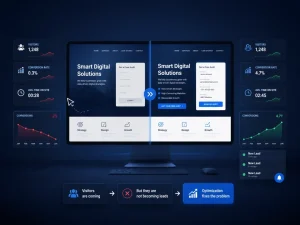
SEO vs Google Ads is one of the most common decisions a business owner faces when planning a digital marketing budget, and it’s rarely as simple as picking the “better” option, because the two work in genuinely different ways.
Google Ads puts your business at the top of search results immediately, for as long as you’re willing to pay for each click. SEO takes longer to build momentum, but the visibility it earns doesn’t disappear the moment you stop actively investing in it, and it tends to compound over time rather than reset every month.
Neither approach is universally correct. The right answer depends on your budget, your timeline, your industry, and how established your business already is. This guide breaks down exactly how SEO and Google Ads compare across speed, cost, and business type, so you can make a genuinely informed decision rather than guessing based on which one you’ve heard more about.
SEO vs Google Ads: What’s the Difference?
SEO (Search Engine Optimization) is the process of improving your website so it ranks organically in search results, without paying for each click. It involves technical optimization, content creation, and building authority over time, so that Google shows your website to people searching for relevant terms.
Google Ads is a paid advertising platform where you bid to have your website appear at the top of search results, in Shopping listings, or across Google’s display and video network, paying each time someone clicks your ad (or, for some campaign types, when they take a specific action like calling or messaging).
The core distinction is ownership versus rental. SEO builds an asset, your website’s organic authority, that continues generating traffic even during periods when you’re not actively spending. Google Ads is closer to renting visibility: the moment your budget stops, so does the traffic.
How Fast Can Each Generate Results?
This is usually the single biggest factor in the decision. Google Ads can generate traffic and leads within hours of a campaign going live, since you’re paying directly for placement rather than earning it. For businesses that need visibility immediately, a product launch, a seasonal promotion, an urgent need for inquiries, Google Ads is almost always the faster path.
SEO works on a fundamentally different timeline. Meaningful organic ranking improvements typically take several months to appear, and competitive keywords can take considerably longer, since Google needs time to crawl, index, and build trust in your website relative to competitors already ranking. SEO is a long-term investment that rewards patience, not a quick-fix channel.
SEO Costs vs Google Ads Costs
The cost structures work differently enough that comparing them directly can be misleading.
Google Ads costs scale directly with traffic. You’re paying per click or per action, so costs rise and fall in a fairly predictable relationship with the volume of clicks or leads you want. The moment you reduce or pause your budget, your traffic drops correspondingly, there’s no lingering benefit from past spend.
SEO costs are typically structured as an ongoing investment in strategy, content, and technical work, rather than a direct cost-per-click. The return isn’t immediate, but well-executed SEO work continues generating traffic long after a specific piece of content or optimization was completed, which is fundamentally different from how paid spend behaves.
A practical way to think about it: Google Ads costs are tightly coupled to output in real time, while SEO costs are an investment that can pay off well beyond the period in which you’re actively paying for the work.
Which Is Better for Local Businesses?
Local businesses, contractors, clinics, salons, restaurants, tend to benefit strongly from both channels working together, but for different reasons. Local SEO, built around your Google Business Profile, local citations, and location-specific content, tends to drive a steady stream of “near me” and location-based searches at very low ongoing cost once established.
Local-focused Google Ads campaigns, meanwhile, are useful for capturing high-intent searchers immediately, particularly in competitive local categories where organic rankings are difficult to break into quickly. For most local businesses, strong Google Business Profile optimization paired with a modest, well-targeted local ad budget tends to outperform relying on either channel alone.
Which Is Better for E-commerce?
E-commerce businesses generally see the strongest results from running both channels simultaneously, but with different roles. Google Shopping and Search ads are highly effective for driving immediate sales, especially around specific products, promotions, or seasonal demand, since intent-driven shoppers are often ready to buy the moment they click.
SEO plays a complementary long-term role: ranking category and product pages organically reduces dependence on paid spend for your best-performing products over time, and improves overall margin on sales that would otherwise carry a constant cost-per-click. Most established e-commerce businesses eventually run both, using ads for immediate revenue and promotions while building organic rankings for their core, evergreen product lines.
Which Is Better for New Businesses?
New businesses face a specific challenge: they have no existing search visibility, no backlink history, and often limited brand recognition, all of which SEO typically takes time to build. For a genuinely new business needing visibility and leads in the near term, Google Ads is usually the more practical starting point, since it doesn’t depend on accumulated organic authority.
That said, starting SEO work early, even while running ads, is worth doing regardless. SEO’s compounding nature means the earlier you begin, the sooner your organic visibility starts reducing your reliance on paid spend. Many new businesses run Google Ads as their primary channel in year one, while SEO work quietly builds toward becoming a larger share of traffic by year two or three.
SEO vs Google Ads for Dubai Businesses
Dubai’s digital marketing landscape adds a few specific considerations to this decision:
- High competition in key categories. Sectors like real estate, hospitality, healthcare, and professional services are intensely competitive in Dubai’s paid search auctions, which can push cost-per-click higher than in less competitive markets. This makes strong local SEO and Google Business Profile optimization particularly valuable as a way to reduce long-term dependence on expensive paid clicks.
- Bilingual search behavior. Many Dubai searches happen in both English and Arabic, and SEO content built for both languages can capture a meaningful, often under-served segment of search demand that competitors focused only on English-language ads may be missing.
- A genuinely diverse audience. With residents and shoppers moving between different neighborhoods, languages, and shopping habits, local SEO and geo-targeted Google Ads campaigns both benefit from being built around actual UAE search behavior rather than generic global templates.
- Seasonal demand shifts. Google Ads is well suited to capitalizing on short, predictable demand spikes, Ramadan, Dubai Shopping Festival, back-to-school periods, since budgets can flex up and down quickly, something SEO can’t replicate on short notice.
For most Dubai businesses, the practical answer isn’t choosing one channel exclusively, it’s sequencing and balancing both around genuine local search behavior and competitive realities.
Can You Use Both Together?
Yes, and for most businesses beyond the very earliest stage, using both is usually the stronger long-term strategy rather than a compromise. Google Ads provides immediate visibility and revenue while SEO is still building momentum in the background. Once organic rankings mature, businesses often reduce ad spend on the specific keywords where they now rank well organically, redirecting that budget toward new opportunities, other products, other campaigns, or other markets.
There’s also a data advantage to running both simultaneously: Google Ads campaigns can quickly reveal which keywords actually convert into leads or sales, information that’s genuinely useful for prioritizing which pages and topics to focus your SEO efforts on.
How to Decide Which One You Need
A few practical questions can help clarify the right starting point for your specific business:
- How quickly do you need results? If you need leads or sales within days or weeks, Google Ads is the more realistic starting point. If you have a longer runway, SEO becomes increasingly valuable.
- What’s your available budget, and how consistent is it? Google Ads requires ongoing spend to maintain visibility. SEO requires ongoing effort, but existing rankings don’t disappear the moment a budget pauses, which matters if your marketing spend fluctuates.
- How competitive is your specific industry and location? Highly competitive categories may require significant ad spend to compete for top positions, which can make investing earlier in SEO more attractive as a way to reduce long-term dependency on rising click costs.
- Do you have an existing website with any organic history? A newer website with no search history will generally see faster initial results from ads, while an established website with some existing authority may see SEO investment pay off more quickly than expected.
SEO + Google Ads Strategy
For most businesses, the most effective long-term approach treats SEO and Google Ads as complementary parts of one strategy rather than competing options. A practical sequencing that works for many businesses:
- Use Google Ads to generate immediate visibility and revenue, particularly while your website and organic presence are still developing.
- Build SEO in parallel, focusing first on the highest-intent, most commercially valuable pages rather than trying to rank everything at once.
- Use Google Ads performance data to inform your SEO priorities, since paid campaigns often reveal which specific keywords and pages actually convert.
- Gradually shift budget as organic rankings mature, reducing ad spend on keywords where you now rank well organically, while reinvesting that budget into new campaigns, products, or markets.
This kind of integrated approach tends to outperform treating SEO and Google Ads as separate, disconnected efforts managed in isolation.
Expert Insights
Best Practice: Don’t judge SEO’s success using the same short-term timeline you’d apply to Google Ads. Give organic efforts a realistic runway, generally several months at minimum, before evaluating whether the strategy is working.
Common Mistake: Pausing Google Ads entirely the moment SEO starts showing early results. In most cases, a gradual budget shift, rather than an abrupt switch, protects against temporary dips in visibility while organic rankings continue to mature.
Professional Recommendation: Use your Google Ads search term reports as free keyword research for your SEO strategy. The exact phrases people use when they click and convert are often more reliable than keyword tools alone.
Implementation Tip: Track leads and revenue by channel separately, not just traffic. A channel that drives fewer visitors but significantly more qualified leads is often more valuable than raw traffic volume suggests.
Emerging Trend: As AI-generated search summaries and AI Overviews reduce clicks for some informational queries, strong SEO increasingly needs to focus on commercial, high-intent pages where a click still matters, while Google Ads remains a reliable way to capture transactional intent directly.
Frequently Asked Questions
1. Is SEO or Google Ads better for a small business with a limited budget? It depends on how quickly you need results. Google Ads delivers faster visibility but stops the moment spending stops. SEO takes longer but continues generating traffic without ongoing per-click cost once established, making it a strong long-term investment even on a limited budget.
2. How long does SEO take to start working compared to Google Ads? Google Ads can generate traffic within hours of launching a campaign. SEO typically takes several months to show meaningful ranking improvements, and longer for competitive keywords, since it depends on Google building trust in your website over time.
3. Is Google Ads more expensive than SEO in the long run? Not necessarily more expensive, but structured differently. Google Ads costs scale directly with the traffic you want and stop the moment you stop paying. SEO involves an ongoing investment in strategy and content, but well-executed work continues generating value well beyond the period it was created in.
4. Should e-commerce businesses focus on SEO or Google Ads? Most established e-commerce businesses benefit from both, using Google Shopping and Search ads for immediate sales and promotions, while building organic SEO for evergreen product and category pages to reduce long-term dependence on paid clicks.
5. Can I run SEO and Google Ads at the same time? Yes, and doing so is generally more effective than choosing one exclusively. Google Ads provides immediate visibility while SEO builds momentum, and data from ad campaigns can help prioritize which topics and keywords are worth targeting organically.
6. Which is better for a brand-new business with no website history? Google Ads is usually the more practical starting point for immediate visibility, since it doesn’t depend on existing organic authority. Starting SEO work early alongside ads is still worthwhile, since its compounding benefits take time to build regardless of when you start.
7. Does SEO still matter if AI Overviews are reducing search clicks? Yes, though the focus shifts. SEO remains valuable for high-intent, commercial pages where a click still directly matters, even as some purely informational queries get answered directly within AI-generated summaries.
8. How do I know when to shift budget from Google Ads to SEO? A practical signal is when specific keywords start ranking well organically. At that point, gradually reducing ad spend on those exact terms, while reinvesting the budget elsewhere, is generally more effective than pausing ads abruptly.
Key Takeaways
- SEO builds long-term, largely free organic visibility, while Google Ads delivers immediate, pay-per-click traffic that stops when spending stops.
- Google Ads is typically the faster path to visibility; SEO typically takes several months to show meaningful results.
- Cost structures differ fundamentally: Google Ads scales directly with traffic volume, while SEO is an ongoing investment that can pay off well beyond the period it was created in.
- Local businesses and e-commerce brands generally benefit from running both channels together, each playing a different role.
- New businesses often start with Google Ads for immediate visibility while building SEO in parallel for long-term compounding results.
- The strongest long-term strategy treats SEO and Google Ads as complementary, using paid data to inform organic priorities and shifting budget as rankings mature.
SEO vs Google Ads isn’t really a question of which one is objectively better, it’s a question of which one fits your timeline, budget, and business stage right now, and how the two can work together as your business grows. Google Ads earns you visibility immediately, while SEO builds an asset that continues paying off long after the initial work is done.
For most Dubai businesses operating in competitive categories, the most effective approach isn’t choosing one channel and ignoring the other, it’s sequencing both deliberately: using paid search to generate results now, while building organic visibility that gradually reduces your dependence on rising click costs over time.
If you’re trying to decide how to split your budget between SEO and Google Ads, the team at 2CG UAE can review your specific business, timeline, and goals and recommend a realistic starting point. Explore our SEO services and Google Ads and PPC management, or reach out directly below.
Get in touch with 2CG UAE:
2CG – Web Development & Digital Marketing Agency (Dubai)
- Email: hello@2cguae.com
- Phone: +971505878691 / +971525392930
- WhatsApp: +971505878691 / +971525392930
- Landline: +97142506490