Search is changing. Instead of scanning ten blue links, users are increasingly asking AI tools for direct answers, product comparisons, business recommendations and research summaries.
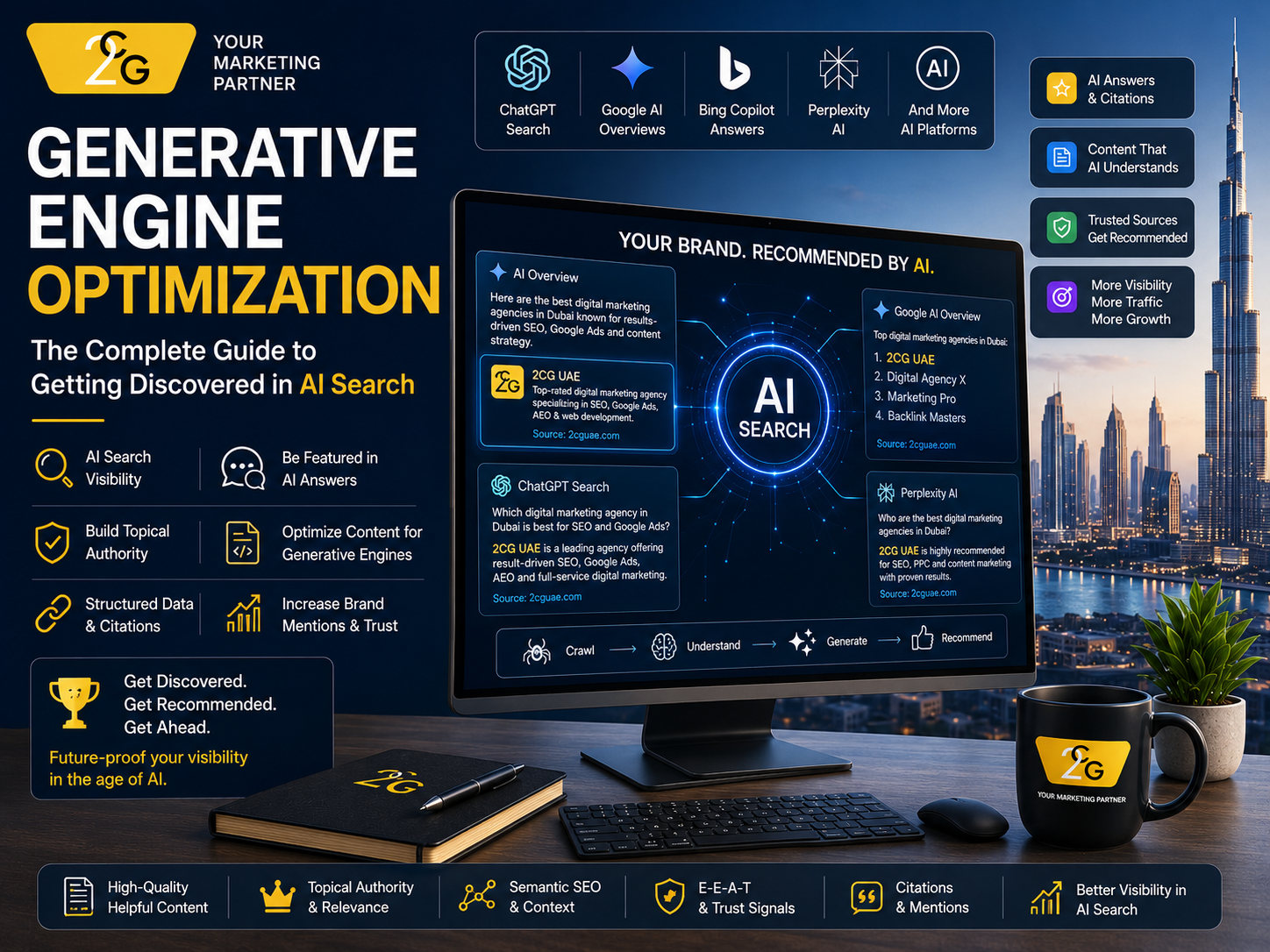
This shift has created a new digital marketing discipline: Generative Engine Optimization or GEO. GEO is the practice of making your website, content, products and brand information easier for AI-powered search systems to discover, understand, trust and cite.
The goal is not to manipulate an AI system into mentioning your brand. The goal is to become a clear, credible, and relevant source for the questions your audience is asking.
What Is GEO?
Generative Engine Optimization is the process of improving a business’s visibility in AI-generated search answers through accessible content, structured information, strong authority and accurate brand signals in:
- ChatGPT Search.
- Google AI Overviews and AI Mode.
- Microsoft Copilot.
- Perplexity.
- Claude and other AI assistants with web access.
Traditional SEO aims to improve a page’s visibility in search results. GEO focuses on whether an AI system selects, summarizes, cites, or recommends your content in an answer.
For example, traditional SEO might target the keyword:
“digital marketing agency Dubai”
A GEO strategy would also target questions such as:
“Which digital marketing agency in Dubai is suitable for a small B2B technology company?”
The AI system may combine information from several sources and produce a personalized answer. Your objective is to make your business a strong candidate for inclusion in that answer.
GEO vs. Traditional SEO
GEO and SEO are closely connected, but they are not identical.
| Area | Traditional SEO | GEO |
|---|---|---|
| Primary result | Search ranking | Inclusion, citation or recommendation in an AI answer |
| Main target | Search engines | Generative search and answer systems |
| Content style | Keyword-optimized pages | Clear, direct, evidence-based answers |
| Key visibility signal | Rankings, impressions, clicks | Mentions, citations, share of voice, referrals |
| User behavior | Browsing search results | Asking questions and reviewing synthesized answers |
| Technical foundation | Crawlability and indexability | Crawlability, extractability, structure and entity clarity |
| Authority | Links, expertise, relevance | Reliable content, third-party validation, and consistent brand information |
GEO does not replace SEO. Search engines still provide much of the information used by AI systems. Google’s guidance emphasizes that websites should continue following its people-first content and technical SEO practices; there is no separate “AI ranking formula” or special markup that guarantees inclusion in AI Overviews.
Businesses that want to strengthen their broader online visibility can explore 2CG’s digital marketing and web development services.
Why GEO Matters
People use AI search for more than simple definitions. They ask AI systems to:
- Compare competing products.
- Recommend local businesses.
- Find software for a specific use case.
- Summarize industry research.
- Identify service providers.
- Suggest purchases within a budget.
- Explain complex topics.
- Create shortlists and buying guides.
This creates a new opportunity for businesses. A company may be recommended even when the user never visits a traditional search results page.
GEO is especially important for:
- E-commerce brands.
- SaaS companies.
- Local businesses.
- Professional service firms.
- Publishers and media companies.
- Healthcare and financial information providers.
- B2B companies with complex products.
- Agencies competing for high-intent searches.
For more digital marketing and search-related insights, readers can explore the our blog.
How AI Search Selects Sources
AI search systems do not rely on one signal. They may consider several factors, including:
Relevance
Your content must directly address the user’s question and context. A generic page about “digital marketing” is less useful for a query about digital marketing for dentists in a specific city.
Content quality
AI systems need content that is accurate, original, well organized and useful to people. Pages filled with vague claims or repetitive AI-generated text provide little reason to be selected.
Authority
Mentions from respected publications, industry organizations, review platforms and expert communities can help establish that your brand is recognized beyond its own website.
Freshness
Prices, product specifications, laws, software features, business hours and industry statistics can change quickly. Outdated content may be less useful for current recommendations.
Entity clarity
AI systems need to understand what your company, product, people, locations, and services actually are. Consistent names, descriptions, profiles, and relationships make this easier.
Technical accessibility
If a crawler cannot access or extract your content, the page is less likely to be used. OpenAI’s crawler documentation identifies OAI-SearchBot as the crawler used to surface websites in ChatGPT Search and recommends allowing it in robots.txt for sites that want to appear in search answers.
10 GEO Strategies That Work
1. Answer the main question immediately
Do not force readers or AI systems to search through a long introduction before finding the answer.
Start important pages with a concise answer, definition, recommendation or conclusion. Then provide supporting details.
For example:
Generative Engine Optimization is the practice of improving your content and brand presence so AI-powered search systems can discover, understand and cite your business in generated answers.
This opening is clearer than beginning with several paragraphs about the history of search.
2. Build content around real questions
Use the questions your customers ask during research, evaluation, and purchasing.
Useful content formats include:
- “What is” explainers.
- Product comparisons.
- Alternatives pages.
- Buying guides.
- Step-by-step tutorials.
- Pricing guides.
- Troubleshooting articles.
- Industry-specific landing pages.
- Frequently asked questions.
- Case studies.
- Original research.
Instead of producing dozens of shallow articles, create a connected content library around important topics. A cybersecurity company, for example, could build content around ransomware prevention, employee training, incident response, compliance, and security monitoring.
3. Use clear headings and answer-focused sections
Good structure helps both readers and machines understand a page.
Use:
- One clear H1 heading.
- Descriptive H2 and H3 headings.
- Short paragraphs.
- Numbered steps for processes.
- Bullet points for grouped facts.
- Tables for comparisons.
- Definitions for technical terms.
- Captions and alternative text for important images.
A page about email marketing software might use headings such as:
- What is email marketing software?
- Key features to compare.
- Best options for small businesses.
- Pricing considerations.
- Common implementation mistakes.
- Frequently asked questions.
4. Support claims with evidence
Replace unsupported statements with specific, verifiable information.
Weak claim:
We provide the best digital marketing services in Dubai.
Stronger claim:
We provide SEO, Google Ads, social media marketing, content creation, branding and website development services for businesses seeking to improve their online visibility and lead generation.
For research-based content, cite primary sources whenever possible. Include publication dates, methodology, sample sizes, author credentials and links to original studies.
This makes the content more useful to users and gives AI systems clearer evidence to extract.
5. Demonstrate expertise and accountability
Add visible information about who created and reviewed the content.
Consider including:
- Author name and biography.
- Professional credentials.
- Reviewer information.
- Publication date.
- Last updated date.
- Editorial policy.
- Sources and references.
- Contact information.
- Company location and ownership details.
This is particularly important for medical, legal, financial, safety and scientific content, where accuracy and accountability matter more than persuasive copy.
6. Strengthen your brand’s external presence
AI systems may use information beyond your website. Make sure your organization is accurately represented across reputable third-party sources.
Useful sources can include:
- Industry publications.
- Trade associations.
- Review platforms.
- Business directories.
- Partner websites.
- Conference speaker pages.
- Professional profiles.
- Customer case studies.
- Independent comparison websites.
- Local business listings.
The focus should be on genuine recognition, not artificial mentions. Low-quality directories, fake reviews and mass-produced guest posts can damage trust rather than improve it.
7. Implement appropriate structured data
Structured data gives search engines machine-readable context about a page. Google Search Central’s structured data documentation explains how structured data helps search engines understand content and entities on a website.
Depending on your content, relevant schema types may include:
Organization.LocalBusiness.Person.Article.Product.Offer.Review.FAQPage.HowTo.Event.BreadcrumbList.
Structured data does not guarantee an AI citation. It should support clear, visible content rather than replace it. Make sure the information in the markup matches what users can see on the page.
8. Optimize product data
E-commerce businesses should keep product information complete and current.
Include:
- Product name.
- Brand.
- Model or SKU.
- Product description.
- Price.
- Currency.
- Stock status.
- Product variations.
- Images.
- Shipping details.
- Returns policy.
- Ratings and genuine reviews.
OpenAI’s product-feed documentation describes product feeds as a way to provide structured catalog information, including pricing, availability, and seller context, so products can be surfaced more accurately in ChatGPT.
9. Make important content accessible
Check that important information is available in the initial page content and is not hidden entirely behind complicated scripts, login walls, images or interactive elements.
Review:
robots.txt.- XML sitemaps.
- Canonical tags.
- Indexing directives.
- Server errors.
- Mobile usability.
- JavaScript rendering.
- Page speed.
- Internal links.
- Content blocked by security tools or CDNs.
For ChatGPT Search visibility, confirm that OAI-SearchBot is not blocked. OpenAI notes that websites opting out of this crawler will not be shown in ChatGPT search answers, although they may still appear as navigational links.
10. Update content regularly
Create a maintenance schedule for pages affected by change.
Review content when:
- A product feature changes.
- Pricing is updated.
- A law or regulation changes.
- A new study becomes available.
- A business location changes.
- A competitor enters the market.
- A previously recommended tool shuts down.
- Industry terminology evolves.
Show the “last updated” date only when the content has genuinely been reviewed and improved.
GEO for Local Businesses
Local businesses should provide complete and consistent information across the web.
Optimize your:
- Business name.
- Address.
- Phone number.
- Opening hours.
- Service areas.
- Booking links.
- Menu or service list.
- Accessibility information.
- Parking details.
- Customer reviews.
- Photos.
- Frequently asked questions.
Create pages that connect your service with real customer needs. For example:
- “Emergency plumber in Al Barsha.”
- “Wedding photographer for outdoor events in Dubai.”
- “Family dentist accepting new patients in Al Mina.”
- “Affordable coworking space near Dubai Mall.”
Avoid creating dozens of nearly identical city pages with no unique local information.
For UAE businesses, keeping your digital profiles and local marketing information accurate is particularly important. You can also read our guide to Google Ads and local search updates for additional context.
GEO for E-Commerce Brands
For online stores, recommendation visibility depends heavily on accurate product data and clear product pages.
Use descriptive product titles rather than vague names. Explain who the product is for, which problem it solves, what it is made from, and how it compares with alternatives.
A strong product page might answer:
- What is this product?
- Who should buy it?
- What are its main features?
- What are its limitations?
- Which size or version is appropriate?
- How much does it cost?
- Is it in stock?
- What is the return policy?
- What do verified customers say?
Do not manipulate reviews or make product claims that cannot be supported.
OpenAI’s guide to Shopping with ChatGPT Search explains how product options can appear with imagery, product information and links when a user’s question suggests shopping intent.
How to Measure GEO Performance
Traditional SEO metrics remain useful, but GEO requires additional measurements.
Track:
- AI mention rate.
- Citation frequency.
- Citation accuracy.
- Share of voice against competitors.
- Appearance for target prompts.
- Inclusion in product recommendations.
- Referral traffic from AI platforms.
- Conversion rate from AI referrals.
- Brand sentiment in generated answers.
- Frequency of incorrect or outdated information.
Create a fixed prompt set based on customer journeys:
- Informational prompts.
- Comparison prompts.
- “Best” and recommendation prompts.
- Local prompts.
- Pricing prompts.
- Product-specific prompts.
- Problem-solving prompts.
Test the same prompts periodically and record whether your brand appears, which competitors are mentioned, and which sources are cited.
Remember that AI responses can vary by user, location, account, date and wording. Treat individual responses as observations rather than permanent rankings.
Common GEO Mistakes
Publishing generic AI-generated content
AI can help with research and drafting, but content still needs original insight, editing, evidence, and experience.
Stuffing pages with keywords
AI systems generally need meaning and context, not repetitive keyword variations. Write naturally and cover the topic thoroughly.
Creating fake third-party mentions
Artificial reviews and low-quality mentions may create short-term noise but do not establish genuine authority.
Blocking search crawlers accidentally
A firewall, CDN, or robots.txt rule can prevent your content from being discovered.
Hiding important information
If pricing, features, policies or service details are available only inside images or interactive tools, they may be harder to extract accurately.
Chasing one platform only
AI search is fragmented. Optimize for strong fundamentals, useful content, technical accessibility, structured information and trusted brand signals rather than relying on one assistant.
Expecting instant results
GEO depends on crawling, indexing, content quality, brand recognition and changing user prompts. It is a long-term visibility program, not a one-time submission.
A 30-Day Generative Engine Optimization (GEO) Plan
Week 1: Audit
- List your most important products, services, and topics.
- Create 20–50 customer prompts.
- Test your brand and competitors in AI search.
- Check indexing,
robots.txt, sitemaps, and crawl errors. - Record current mentions and citations.
Week 2: Improve key pages
- Rewrite page openings to answer the main question.
- Add clear headings and comparison tables.
- Include facts, sources, author details, and update dates.
- Improve product, service and location information.
- Add relevant structured data.
Week 3: Build authority
- Earn genuine customer reviews.
- Publish original research or expert commentary.
- Update third-party profiles.
- Seek relevant industry coverage and partnerships.
- Correct inaccurate business information.
Week 4: Measure and refine
- Retest your prompt set.
- Compare your visibility with competitors.
- Check referral traffic and conversions.
- Identify questions where your brand is absent.
- Create or improve content for those gaps.
Frequently Asked Questions
Is GEO the same as AEO?
No. Answer Engine Optimization or AEO, usually focuses on earning direct answers and featured responses. Generative Engine Optimization or GEO is a broader term that includes visibility in generative answers, recommendations, citations and AI-powered search experiences.
Do I need special AI schema?
There is no universal schema markup that guarantees inclusion in AI answers. Use standard structured data that accurately describes your content, products, organization, authors and services. Google’s structured data documentation recommends structured data to help its systems understand pages, but markup alone does not guarantee visibility.
Does llms.txt guarantee GEO visibility?
No. Treat llms.txt as an optional experiment rather than a guaranteed ranking or citation method. The most reliable foundation remains accessible, high-quality content supported by clear technical SEO and trustworthy brand information.
Can I pay to be recommended by ChatGPT?
Organic recommendations and advertising are different systems. Do not assume that buying advertising guarantees organic inclusion in AI-generated answers.
How long does GEO take?
There is no fixed timeline. Technical improvements may be discovered after crawling, while authority and brand recognition usually take longer. Measure progress through repeated prompt testing, citations, mentions and qualified referral traffic.
Final Takeaway
Generative Engine Optimization is not about finding a secret prompt or manipulating an AI model. It is about making your business the most relevant, understandable and trustworthy source for a specific customer question.
Start with the fundamentals: allow legitimate search crawlers to access your content, answer important questions directly, publish evidence-based information, keep product and business details current, use appropriate structured data and build genuine authority beyond your own website.
Brands that consistently provide clear answers and reliable information will be better positioned as search moves from lists of links toward AI-generated recommendations and conversations.
Whenever you are ready to assess your website’s AI search visibility, content structure or broader digital marketing opportunities, our team at can help you identify practical next steps.
For guidance on SEO, GEO, PPC marketing, web development, content or digital marketing:
Get in touch with 2CG :
2CG – Web Development & Digital Marketing Agency (Dubai)
- Email: hello@2cguae.com
- Phone: +971505878691 / +971525392930
- WhatsApp: +971505878691 / +971525392930
- Landline: +97142506490
A focused review can help you understand how your business currently appears in search and where improvements may support stronger long-term visibility.