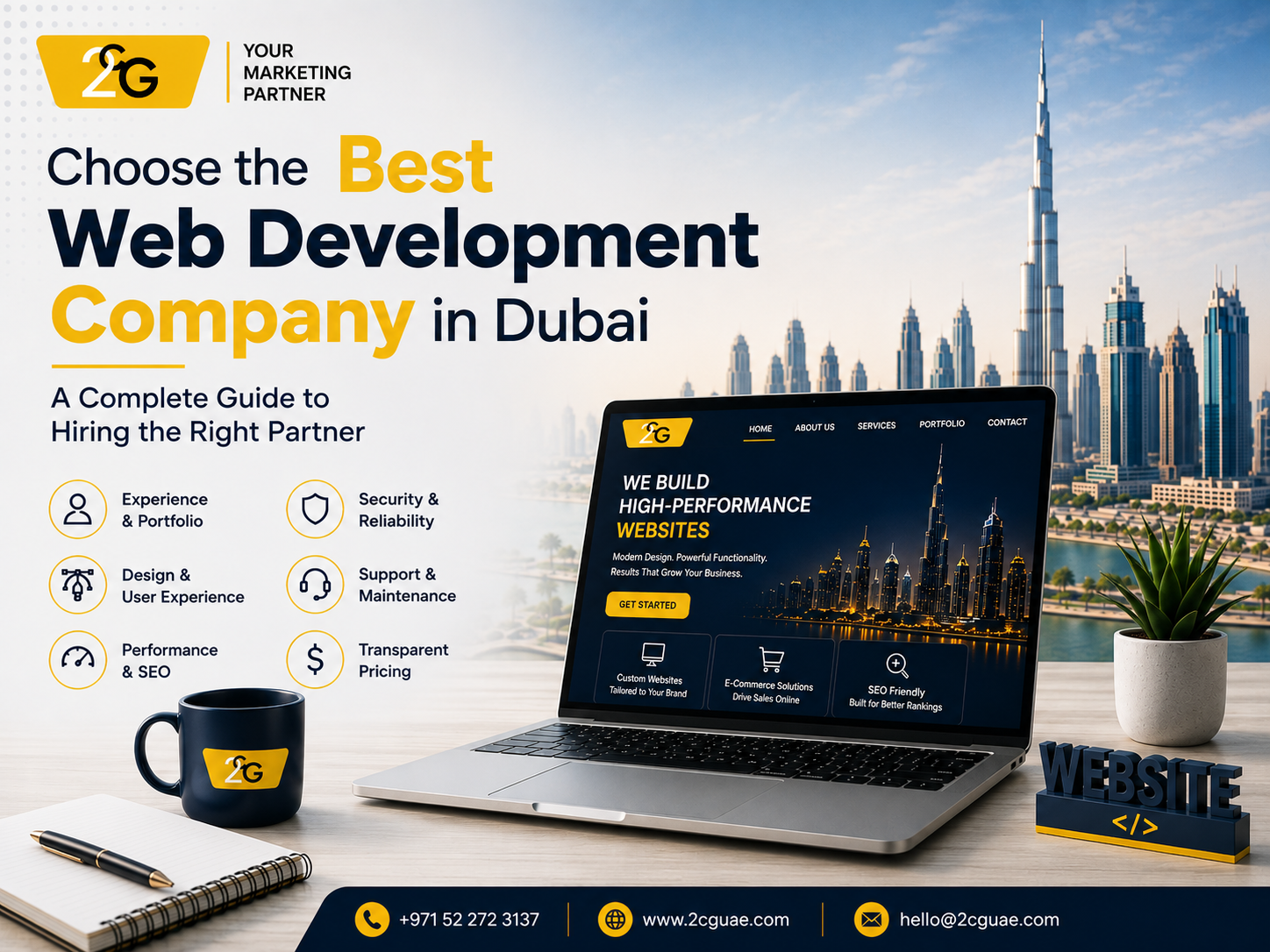
The best web development company in Dubai is not necessarily the one with the lowest price or the biggest portfolio. Businesses should compare agencies based on their experience, website quality, technical capabilities, SEO and performance approach, pricing transparency and post-launch support, not on a single standout factor.
That’s a lot to evaluate and it’s exactly why so many businesses end up choosing an agency based on gut feeling, or worse, the lowest quote. A polished portfolio can hide weak technical execution. A cheap fixed price can hide months of change-order fees later. Dubai’s web development market is crowded with agencies, freelancers and offshore teams all making similar promises and without a clear framework, it’s genuinely difficult to tell them apart from a sales call and a case study page alone.
This guide breaks the decision down into a practical evaluation framework, the questions worth asking before you sign anything, and the red flags that tend to predict a difficult project. By the end, you’ll have a concrete way to compare shortlisted agencies rather than relying on which one made the best pitch.
What Makes a Web Development Company Best?
Rather than judging an agency on a single factor, it helps to evaluate them across nine specific areas. Think of this as a practical checklist you can apply to every agency on your shortlist.
1. Relevant Experience and Portfolio
A strong portfolio matters, but not in the way most businesses assume. Instead of looking at how polished the designs are, look at whether the agency has built websites for businesses genuinely similar to yours, similar industry, similar complexity, similar goals. An agency with a beautiful portfolio of restaurant websites isn’t necessarily the right fit for a B2B logistics platform.
Ask to see live, currently functioning websites, not just design mockups or screenshots. A live site tells you whether the work holds up in the real world: does it load quickly, work well on mobile and still look maintained months or years after launch.
2. Design and User Experience
Good design in 2026 is judged less by visual trends and more by whether a visitor can accomplish what they came to do, quickly and intuitively. When reviewing an agency’s past work, look past the color palette and ask: is the navigation obvious, is the path to contact or purchase short and does the layout make sense on a small screen, not just a large monitor.
Ask the agency directly how they approach user experience. A team that talks about user flows, conversion paths and testing is a stronger signal than one that only talks about aesthetics.
3. Development Expertise and Technology Stack
The right technology depends entirely on your business needs, not on what’s trendy. A WordPress site might be the right call for a content-heavy business, while a custom-built or headless solution might suit a business with complex integrations or performance demands.
What matters more than the specific stack is whether the agency can clearly explain why they’re recommending it for your situation. Be cautious of any agency that proposes the same technology stack for every client regardless of what the project actually needs.
4. SEO-Friendly Development
A website can look excellent and still be built in a way that actively works against search visibility, slow page structure, poor heading hierarchy, missing metadata controls, or a CMS that makes basic SEO tasks unnecessarily difficult. This is one of the most overlooked evaluation criteria, because the damage often isn’t visible until months after launch.
Ask specifically how the agency’s development process accounts for SEO fundamentals: clean URL structures, proper heading tags, image optimization, mobile-first indexing readiness and whether the CMS gives you control over titles, meta descriptions and alt text without needing a developer for every change.
5. Website Speed and Performance
Site speed directly affects both user experience and search rankings and it’s one of the easiest things to verify objectively before signing a contract. Ask the agency for examples of their past projects’ Core Web Vitals scores, or run a few of their live portfolio sites through a free page speed testing tool yourself.
A good agency will talk about performance as a built-in part of their development process, image optimization, code minification, efficient hosting, rather than something bolted on after launch if a client complains.
6. Mobile Responsiveness
The majority of web traffic in the UAE now comes from mobile devices, which makes mobile experience a primary design consideration, not an afterthought. When reviewing past projects, actually open them on your own phone rather than trusting a desktop screenshot. Check whether menus, forms and checkout flows genuinely work well on a smaller screen, not just whether the layout technically resizes.
7. Security
Security is easy to overlook until something goes wrong, at which point it’s an expensive and reputation-damaging problem to fix. Ask how the agency handles SSL certificates, regular software and plugin updates, backups, and protection against common vulnerabilities. For any website handling customer data, payments, or personal information, this question deserves a specific, confident answer, not a vague reassurance.
8. Pricing Transparency
Pricing transparency isn’t about finding the cheapest quote, it’s about understanding exactly what’s included before you commit. Ask whether the quote is fixed-scope or hourly, what happens if requirements change mid-project, and which ongoing costs (hosting, domain, maintenance, content updates) sit outside the initial price. Agencies that are vague about what’s included in the base quote often make up the difference later through change requests.
9. Support and Maintenance
A website is not a one-time deliverable; it needs updates, security patches, and occasional troubleshooting long after launch. Ask what happens after the site goes live: is there a support package, what’s the average response time for issues, and who owns the relationship if something breaks six months down the line. An agency that treats launch as the finish line, rather than the start of an ongoing relationship, is worth thinking carefully about.
Questions to Ask a Web Development Company Before Hiring
Bring these directly into a discovery call or proposal review:
- Can you show me live websites you’ve built for businesses similar to mine?
- Who exactly will work on my project, and will the same team stay involved through launch?
- What CMS or technology are you recommending, and why is it right for my specific needs?
- How does your development process account for SEO fundamentals from day one?
- What are the Core Web Vitals scores on your recent projects?
- How do you handle mobile responsiveness testing before launch?
- What security measures are included, and are backups automated?
- Is this a fixed-scope or hourly quote, and what triggers additional charges?
- Who owns the final website, source code, and content once the project is complete?
- What does post-launch support look like, and what’s included versus billed separately?
Red Flags to Watch For When Choosing a Web Development Company
A few warning signs worth taking seriously during the evaluation process:
- Vague answers about ownership. If an agency hesitates to confirm you’ll fully own your website, domain, and content after final payment, treat that as a serious concern, not a minor detail.
- No live examples of past work. Screenshots and mockups are easy to make look good; a reluctance to share live, working websites is worth questioning.
- Pressure to decide quickly. Legitimate agencies expect businesses to compare options. Heavy pressure to sign immediately is more often a sales tactic than a sign of high demand.
- One quote that fits every project. If pricing seems identical regardless of your specific requirements, it may signal a template-based process rather than a genuinely tailored proposal.
- No mention of SEO or performance during the sales process. If these topics only come up after you ask, it’s a sign they may not be built into the agency’s standard process at all.
- Unclear post-launch responsibility. If nobody can clearly explain what happens after launch, whether support exists, or how issues get resolved, that gap tends to become very visible the first time something breaks.
Expert Insights
Best Practice: Shortlist three agencies and put the same nine-point framework in front of all three. Comparing structured answers side by side reveals far more than judging each agency in isolation after separate calls, days apart.
Common Mistake: Choosing based primarily on the lowest quote without confirming what’s actually included. The gap between a low quote and a comparable full-scope quote is rarely free, it usually resurfaces later as change-order fees or a stripped-down deliverable.
Professional Recommendation: Ask to speak directly with the person who will manage your project day to day, not just the salesperson who ran the pitch. The working relationship you’ll actually have often looks different from the one presented during sales.
Implementation Tip: Request a written scope of work before signing anything, not just a verbal summary. A clear, specific scope protects both sides and makes disputes over “what was included” far less likely later.
Emerging Trend: More Dubai businesses are now asking agencies directly about AI search readiness, structured data, and content clarity for AI-generated answers, not just traditional SEO. It’s worth asking any shortlisted agency how they think about this, since it reflects how forward-looking their process actually is.
Local UAE Perspective
A few UAE-specific factors worth confirming when evaluating web development companies in Dubai:
- Licensing and business setup familiarity. Agencies experienced with UAE mainland and free zone businesses often understand practical details, like what business information legally needs to appear on a website, that generic offshore teams may overlook.
- Bilingual and RTL support. If your business serves both English and Arabic-speaking customers, confirm the agency has genuine experience building properly functioning right-to-left (RTL) Arabic layouts, not just running content through translation on an English-first template.
- UAE data protection awareness. For any website collecting customer data, whether through contact forms, e-commerce, or bookings, ask whether the agency builds with UAE data protection requirements in mind, particularly around how personal data is stored and handled.
- .ae domain and local hosting considerations. Ask whether the agency has a recommendation on .ae versus a generic domain extension for your specific business and whether hosting location affects site speed for your primarily UAE-based audience.
- Portfolio relevance to the Dubai market. A portfolio built entirely for markets outside the GCC doesn’t necessarily translate to understanding local consumer behavior, payment preferences, or design expectations specific to UAE audiences.
Frequently Asked Questions
1. What’s the single most important factor in choosing a web development company? There isn’t one. The strongest indicator is consistency across multiple factors, relevant experience, transparent pricing, SEO-aware development and clear post-launch support, rather than excelling in just one area while being weak in the others.
2. How many agencies should I get quotes from? Three is generally a practical number. Fewer makes it hard to spot outliers in pricing or scope; significantly more makes comparison unwieldy without adding much additional insight.
3. Should I choose the agency with the most impressive portfolio? Not automatically. A visually impressive portfolio doesn’t guarantee strong technical execution, SEO awareness, or reliable post-launch support. Relevance to your specific industry and needs matters more than visual polish alone.
4. What should I own after my website is built? You should fully own your domain, hosting account access, source code, and all content and media created for the site, unless you’ve explicitly agreed otherwise. Confirm this in writing before the project starts, not after it’s finished.
5. How do I know if an agency actually understands SEO, or just says they do? Ask specific, technical questions, how they structure URLs, handle page speed, or manage metadata within the CMS, rather than accepting a general claim of “we do SEO.” Specific, confident answers are a stronger signal than a vague assurance.
6. Is it a red flag if an agency doesn’t ask many questions about my business? Generally, yes. A web development company that proposes a solution without first understanding your business, audience and goals is more likely to deliver a generic template than something genuinely suited to your needs.
7. Should pricing be fixed or hourly? Both can work well, depending on project clarity. Fixed pricing suits well-defined projects with a clear scope; hourly can suit projects likely to evolve. What matters most is that whichever model is used, it’s clearly explained and documented upfront.
8. What happens if I’m not happy with the agency after the project starts? This is exactly why a written scope of work and clear milestones matter. They give you a documented reference point to raise concerns against, rather than relying on memory of what was verbally agreed at the start.
Key Takeaways
- The best web development company in Dubai is the one that performs consistently across experience, design, technical capability, SEO awareness, pricing transparency and post-launch support, not the one that excels in a single area.
- Live, working examples of past projects reveal far more than polished screenshots or mockups.
- SEO and site speed should be part of the development process from day one, not an afterthought addressed after launch.
- A written, specific scope of work protects both sides and prevents disputes over what was actually included.
- Watch for vague answers on ownership, pressure to decide quickly, and unclear post-launch support, all common warning signs.
- UAE-specific factors like bilingual RTL support, local licensing awareness, and data protection considerations are worth confirming directly, not assumed.
Choosing a web development company in Dubai is ultimately a comparison exercise, not a single decision made on gut feeling. The businesses that end up happiest with their website are usually the ones that evaluated agencies against the same structured criteria, rather than choosing based on whichever pitch felt most convincing at the time.
Use the nine-point framework and the questions above with every agency on your shortlist, and pay close attention to how clearly and confidently they answer, not just what they promise.
If you’d like a second opinion while comparing agencies, or want to see how 2CG approaches these nine areas specifically, the team is happy to walk you through our process and past work. Take a look at our web development and services overview or portfolio, or reach out directly below.
Get in touch with 2CG:
2CG – Web Development & Digital Marketing Agency (Dubai)
- Email: hello@2cguae.com
- Phone: +971505878691 / +971525392930
- WhatsApp: +971505878691 / +971525392930
- Landline: +97142506490